
New e-Book: Current Knowledge about Electromagnetic Hypersensitivity (Ehs)
/
image from the e-book
Michael Bevington, chair of Trustees at Electrosensitivity UK, reviews the current knowledge about electromagnetic sensitivity, a rapidly advancing area of biophysics.
The e-book is short and highly readable. This article contains highlights from his e-book.
What Is EMF Sensitivity?
Electromagnetic sensitivity, which includes Electromagnetic Hypersensitivity (EHS), is a physical reaction to radiofrequency radiation (RFR) and electromagnetic fields (EMFs).
This means you could be experiencing health reactions to being around RFR sources: mobile phone masts, mobile phones, Wi-Fi, Bluetooth, smart meters, smart watches, smart glasses, trackers and similar devices.
You could be experiencing symptoms being around other EMFs, such as power lines, electric cables, inverters, transformers, electric motors and switched-mode power supply.
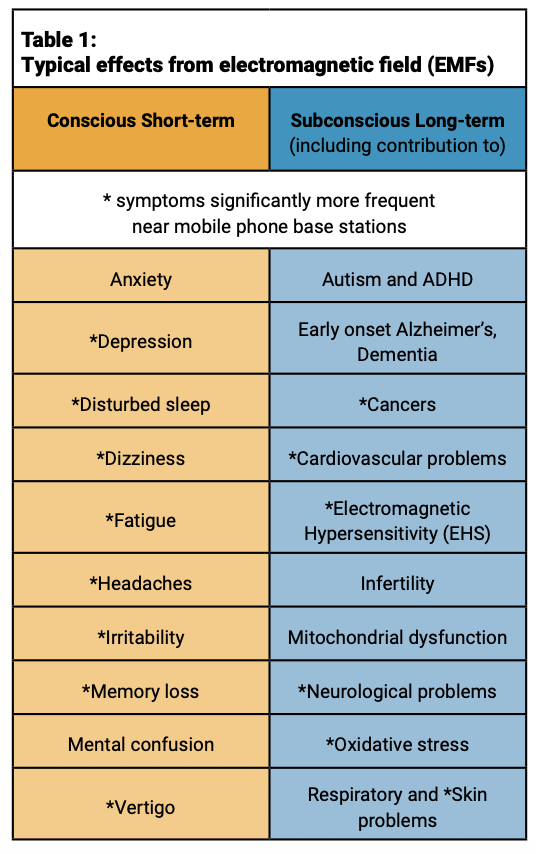
EMF sensitivity has been recorded since at least 1733 (Table 1).
Those sensitive to EMFs can also be affected by the EMFs retained in other people’s bodies. Since 1730 it has been shown that the human body can hold electric charges induced wirelessly, where cellular water is especially sensitive.
This e-book clarifies basic misconceptions:
1—EMF sensitivity is physical, not psychological
You cannot be psychologically primed to be EMF sensitivity. It’s not in your head. Children and adults who have not a clue about what EMFs are can experiencing symptoms related to EMFs. Take them away, and they get better.
Perhaps one more compelling reason is that microwave attacks have been used as a military tool since 1953. The 2017 Havana embassy attacks produced physical symptoms and brain damage revealed by MRI scans—again, that’s physical, not imagined.
Even plants, animals and insects are sensitive to EMFs.
2—EMF sensitivity increases risk of cancer, infertility and neurological harm
Since 1953 it’s been known that radar workers tend to get particular cancers. ELF-EMFs from power lines and wiring were established as carcinogenic since 1979.
3—EMF mechanisms, pathways and genetic factors are complex
We now know more of the numerous downstream pathways such as ion flux.This effects a range of physiology from mitochondria, myelin (in the nervous and brain), melatonin (an important anti-cancer antioxidant), mast cells that control allergic and skin conditions, and many more cells and systems.
EMF Hypersensitivity Is An “Escalating Humanitarian Crisis”
The ICBE-EMF want to see EHS formally recognised as an EMF-induced external cause of injury by public health agencies. This will help those who are EHS-disabled have better acess to the “safer homes, healthcare, education, employment, opportunities, amenities, and equity of access in all public domains”.
If we don’t see or recognise a physical pollutant such as EMFs, we cannot safeguard our health against it, nor can we build better homes and public spaces.
We are all sensitive to EMFs
Mainstream researchers continue to label EMF harm and/or sensitivity as a conspiracy theory. But Physical sensitivity to electromagnetic fields (EMFs) has been known for almost three centuries.
Charles Du Fay, a scientist and Fellow of the Royal Society of London, reported typical EHS symptoms in 1733. Other Fellows reported symptoms of hypersensitivity from 1746 after the Leyden Jar was invented.
Well-known people who have suffered EHS include Nikola Tesla, the electrical engineer, and Dr Gro Harlem Brundtland, the medical physician who was Norway’s first female Prime Minister and Director-General of the World Health Organization (WHO).
Every cell in the body is sensitive to EMFs. All humans require ultraviolet B EMF radiation to produce Vitamin D3. However, humans vary genetically in their sensitivity to these native EMFs. Some experience suntan. Only a few are hypersensitive, suffering sunburn or DNA damage and skin cancer.
You can read the e-book here for free.
Notes:
One of the most renowned case of EHS is the reported hypersensitivity of Gro Harlem Brundtland, the former Prime Minister of Norway. She was the Director-General of the World Health Organization (WHO) from 1998 to 2003. She had not publicly talked about her EHS for more than 10 years. However, that ended when she told a reporter from the Dagbladet newspaper, "I avoid talking on mobile phone," in response to a newspaper article alleging that she now uses a mobile phone.
I maintain a growing library of EMF resources and knowledge. Find more books on EMFs here.


