
Research: Exposure Limits to Radiofrequency Emf Do Not Account for Cancer Risk or Reproductive Toxicity Assessed from Data in Experimental Animals
/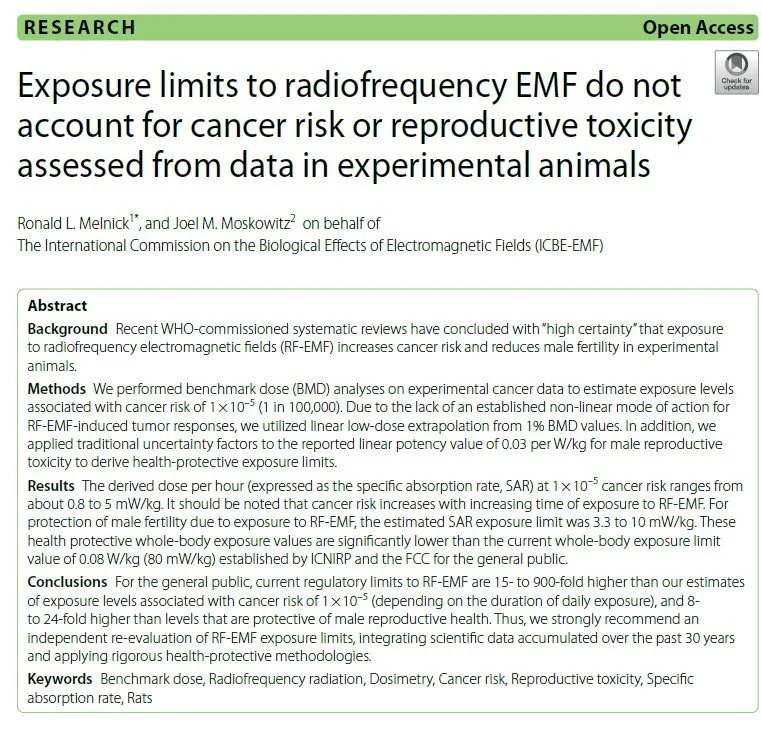
A new peer-reviewed study published in the journal Environmental Health reveals that current safety limits for radiofrequency radiation (RFR)–emitted by cell phones, Wi-Fi routers, smart meters, and cell towers—are severely inadequate to protect public health.
Taking results from a $30 million U.S. National Toxicology Program (NTP) cancer study, the researchers applied standard procedures developed by the U.S. Environmental Protection Agency and found that current RFR exposure limits are at least 200 times too high to protect us from cancer risk with 8 hours per day of exposure.
Also, based on other research, RFR limits were 24 times too high to protect against reproductive impacts.
Conclusions
We already know that exposure to radiofrequency electromagnetic fields (RF-EMF) increases cancer risk and reduces male fertility in experimental animals. The WHO’s own commissioned systematic reviews have concluded these with “high certainty”.
The study concludes:
The ICNIRP and FCC exposure limits to RF-EMF are wholly inadequate for protecting human health.
Those limits need to be markedly reduced to be consistent with how public health agencies set exposure limits to reduce health risks in the general public from exposures to hazardous environmental agents.
To reduce extra cancer risk from exposure to RF-EMF to 1 × 10⁻⁵, the whole-body exposure limit would need to be reduced by 15- to more than 900-fold, with exposures that vary from 1 to 8 h/day.
To reduce the risk of reduced male fertility in the general public, the ICNIRP and FCC limit would need to be reduced by 8- to 24-fold.
We need an independent re-evaluation of RF-EMF exposure limits based on scientific knowledge gained over the past 30 years and the application of health protective methodologies.
Study:
Melnick, R. L., & Moskowitz, J. M. (2026). Exposure limits to radiofrequency EMF do not account for cancer risk or reproductive toxicity assessed from data in experimental animals. Environmental Health. https://doi.org/10.1186/s12940-026-01288-6


