The Complete Guide: Are You Sensitive to Electromagnetic Fields?

UPDATED 15/4/2026

  • What is Electromagnetic Sensitivity or EHS?

  • My EHS Story

  • What Causes Electromagnetic Hypersensitivity or EHS?

  • Who Is Most Electrosensitive?


What are EMFs?

EMFs, or electromagnetic fields, are invisible areas of energy. Anything that is electrically charged can generate EMFs, everything from the sun to your cell phone.

But we are talking about manmade EMFs here, often associated with aforementioned cell phone, as well as electrical power.

In my assessments, I cover four specific types of this artificial radiation.

We can also think of EMFs as low frequency and high frequency. The low-frequency EMFs come from electrical sources such as power lines, electrical wiring, and appliances such as your washing machine, air-con, and refrigerator. On the other hand, high-frequency EMFs are emitted by wireless devices, including your cell phone, iPad, and Wi-Fi router.

In this article, I focus on the symptoms of EMF sensitivity. Once we learn more about what EMFs are, their sources (ubiquitous and probably in your own hand right now), and their potential effects, we understand more about our health.

What is Electromagnetic Sensitivity or EHS?

This is the term given to people who report health issues asociated with EMFs, often to debilitating effects.

These Electromagnetic Fields (EMFs) created by devices like smartphones, WiFi routers, and home appliances in the form of wireless radiation. They may be other forms of EMFs such as magnetic and electrical fields created by other appliances and structures such as power lines.

These energy fields are invisible and can affect our health in ways we may not immediately recognise.

Symptoms of EHS

To understand By now you might be familiar with the common symptoms of EHS: headaches, fatigue, sleep disturbances, skin irritation, dizziness, and difficulty concentrating.

But aren’t these common health issues anyway?

Here is how to tell if your symptoms are related to EMFs.

1—Headaches

Our brain is a massive energy hog. Even mild thirst or when your body is dehydrated (doesn't get the fluids it needs) can cause headaches.

If your headaches are frequent and/or severe, often worsening with increased EMF exposure, they are likely related to EMFs..

2—Fatigue

If you wake up still feeling tired, you might be sensitive to EMFs, because they disrupt circadian rhythms by interfering with melatonin production and altering sleep patterns.

When you are struggling with EHS, you feel persistent tiredness that does not improve with rest.

3—Sleep Disturbances

Relatedly, you find it difficult to go to sleep, or even stay asleep. You wake at night, even though you’ve the best blackout curtains. Such difficulty falling asleep or staying asleep, often linked to the presence of electronic devices.

4—Skin Irritation

The skin is related to our gut, which is why food allergies manifest as eczema, psoriasis, etc. EMFs, too, can trigger the skin directly. Symptoms may include redness, tingling, or burning sensations on the skin.

5—Dizziness

You get a sense of sensation of lightheadedness or imbalance, particularly in environments with high EMF exposure. You might actually get dizzy to the point of fainting.

6—Difficulty Concentrating

You might have trouble focusing or maintaining attention, which can affect daily activities.

We talk about generation brain rot. But it is no coincidence that our youth are the first ones growing up in a digital era.

Gen Z grew up in a screen-saturated world. Compared to Gen Z, many Generation Alpha children (born during 2013) were given iPads around the age of 2 to 4, growing up with a tablet already in front of them.

The science is clear on how screen overuse leads to concentration problems

7—Mood Swings

It is not right to feel your emotions swing. You might feel mood swings with rapid changes in mood, including irritability or anxiety, even anger.

8—Muscle Pain

This is generalized pain or discomfort in muscles, without any other cause. You have not recently hurt yourself. You’ve not been working out too much, etc. Sometimes the pain resembles fibromyalgia.

9—Heart Palpitations

You might feel noticeable changes in heart rhythm, which may occur in high EMF areas.

10—Sensitivity to Noise

You develop a sensitivity to sounds, which you have never had before. This can be any sound, whether crowded malls or people talking normally nearby, which can exacerbate feelings of discomfort.

There are many other symptoms. These are the EHS, Electromagnetic Sensitivity, or EMF exposure are confirmed in the research below:

  • Headaches [6]

  • Lack of Appetite [1]

  • Digestion problems [2]

  • Anxiety [1,5]

  • Sleep Difficulties [1,2,3]

  • Unstable moods and Bursts of anger Due to Poor Sleep [1]

  • Depression [1]

  • Fatigue [1]

  • Lack Of Concentration [1,6]

  • Irritability [1]

  • Memory problems [1,6]

  • Visual problems- blurry vision [1,2]

  • Vertigo or Dizziness [1,2]

  • Tinnitus or Ringin In The Ears [2,3,6]

  • Abdominal Swelling [2]

  • Burning pain in hands, shoulders, legs and feet [2]

  • Itch [4]

  • Edema, swelling, bloating [2,4]

  • Chills [2]

  • Photosensitivity

  • Tachycardia [2,5]

  • Heart Palpitations [2,4,5]

  • Difficulty Breathing [2]

  • Cystitis [2]

  • Skin Rashes [1,4]

  • Heightened sensitivity to touch, smells, chemicals, light, and noise [6]

  • Weakness [6]

These symptoms can occur immediately, minutes or hours later, or over months or years.

When exposure continues, you develop a higher risk of brain and gut issues, reduced cognition, and cancer.

My EHS Story

For example, I lived with near-daily bouts of dizziness, headaches, and even migraines. When I got my first iPad, I developed heart palpitations, although I still did not put two and two together.

When I got pregnant, these symptoms magnified seemingly overnight. Some grew louder over subsequent weeks. Other symptoms emerged: extreme fatigue, difficulty concentrating, digestive issues. The doctors assured me that most pregnant women feel awful.

But my symptoms did not alleviate throughout pregnancy, nor after giving birth. They seemed to increase or decrease inexplicably. Until I connected them to my environment, especially my home and my workspace.

What Causes Electromagnetic Hypersensitivity or EHS?

These sources can be outdoors, but are more often than not found indoors in your own home.

Indoor sources:

  • Cellphones

  • Wi-Fi

  • Smart meters

  • Microwave oven

  • Alarm systems (i.e., motion-detectors)

  • LED lights, dimmers (emit unclean electricity)

  • Cordless phones

  • Washing machines

  • Electric heating located under your floors

  • Plasma TV monitors

  • Any other “Smart” appliances

  • Electric Blanket

  • Wired Clock Radio

Outdoor sources:

  • power lines

  • cellphone towers

Electric vehicles are another source of EMFs. You could argue that they an indoor source since they affect you sitting inside.

Who Is Most Electrosensitive?

Children are more susceptible to the potential effects of EMFs due to their developing bodies and brains. Their skull is thinner, their brain contains more water and fat, and their nervous system is still developing.

In fact, studies have shown that kids can absorb twice as much radiation in the head, and ten times as much in the bone marrow, compared to adults.

Children are also growing up in a wireless radiation soup. Science has shown how EMFs weaken the blood-brain barrier, alter gene expression, and interfere with hormone production.

This is why EMF awareness is crucial to secure our health today and that of future generations. This is why EMF awareness IS protection for children.

Simple strategies are:

  • limiting screen time

  • keeping wireless devices out of bedrooms

  • using wired devices whenever possible

These to help protect your children from some excess EMF exposure.

But children need protection from the environmental stress caused by invisible EMF fields. This means rethinking what’s in your home and what’s near your child 24/7. This is why I include other components of a calm safe home in an EMF-focused consultation; they go hand in hand.

On top of that, EMFs may be invisible but we can talk about it. Educate your children about the potential risks of extended electronics usage and encourage safe technology use.

Given the proliferation of digital infrastructure and the very real ways we are seeing degenerative health in digital lifestyles, I am so glad to more awareness is growing about this topic.

But we can do more and change the one place that we spend our lives and create most of our core memories with—the home.

Building Biology Home: Creating the Home to Protect Our Families
If you are serious about raising healthier kids in a wireless world, you are in the right place.

If you want to learn more about EMFs and building biology principles to create a calm home, subscribe to my newsletter. I share how to create a calm with practical truth, not fear.

Get started now with my EMF Bootcamp to eliminate, once and for all, the most common toxin in your space. In this bootcamp, you will understand the importance, types of EMFs, and effective strategies for your defense against EMF exposure.

Do you want an EMF-safe home? Work with me.


References and resources about EHS symptoms:

[1] Gómez-Perretta cell radiation exposure stud
[2] Piras et.al. Fibromyalgia and EHS Study 
[3] Bhat, Kumar Gupta Study of the Effects of Radiations Study of the Effects of Radiations  
[4] Johannson Immune system and electromagnetic fields study             
[5] Magda Havas Wireless Radiation and Autotomic system study 
[6] Gunnar Heuser Functional MRI and EHS Study


What Are EMFs? 7 Things You Need to Know as a Mother

You probably hear about EMFs and its associated risks in the devices, content, and habits that we have, but what exactly does it mean? And what does it mean if you have children or are planning for a family?

In this article, you’ll learn what is EMFs and how they’re negatively affecting the health of children, in particular concerns around fertility, conception, birth and all through the crucial years of child development.

What are EMFs?

EMFs are invisible and completely beyond most people’s awareness. However, some people can actually feel them. Especially those that are manmade (non-native electromagnetic radiation).

The Electromagnetic Spectrum

The simplest way to understand how important EMFs are to our health – is by learning about the electromagnetic spectrum.

contains the entire range of all electromagnetic radiation. It also shows the field’s approximate frequency – which relates to its wavelength.

At the absolute lowest frequencies in the hertz range, we see the largest wavelengths. These are the size of several thousand miles! The lowest of frequency fields includes the Earth’s Schumann Resonance, which is also very healing for us when we are grounded in Nature to its energy.

The higher in frequency, the field gains more energy, and also reduces in wavelength. (That’s why wireless radiation is often called pulse radiation to describe its very high energy field.) In fact, at the frequency of Wi-Fi, your body is being exposed to 2.4 or 5 billion pulsations per second. Compare that to the natural Schumann Resonance, which has just 8 gentle cycles per second.

EMFs may be triggering your child’s hungries

In healthy participants and compared with no exposure, 50-minute cell phone exposure was associated with increased brain glucose metabolism in the region closest to the antenna. Link to the study: https://jamanetwork.com/journals/jama/fullarticle/645813

Light can cause breast cancer

75 studies and articles showing effects of EMFs and the initiation and promotion of breast cancer.

https://emfrefugee.blogspot.com/2019/06/emfs-and-breast-cancer.html?m=1

2008 – Austria – Cell Phone Towers and CancerA study by Austrian Dr. Gerd Oberfeld (EMFacts 2008) showed a 23-fold increase in breast cancer and a 121-fold increase in brain tumors for those who lived with 200 meters of a cell phone base station for five years or longer! http://www.verwaltung.steiermark.at/cms/ziel/21212/DE/

EMFs may be harming your chances of conception

There’s enough compelling evidence to show how higher levels of exposure can reduce sperm quality in men.

It can also increase miscarriage risk in women. Two miscarriage studies, conducted by Kaiser Permanente and funded by the National Institute of Environmental Health Sciences, are particularly interesting because they're some of the only ones to date that actually measured EMF exposure in subjects using a magnetic field monitoring device.

"We took [913 pregnant women] and asked them to wear the monitor for the duration of their pregnancy. Studies right now aren't using the meters because most of them are focusing on cancer. [But] Cancer can take 20 years to develop—you can't measure your exposure from 20 years ago, so in those cases, you just ask how much the person uses their cell phone." — eproductive epidemiologist De-Kun Li, MD, PhD, the principle investigator on both studies (one published in 2002, one published in 2017).

Singapore breast cancer statistics

What does your bedtime routine have to do with your breast cancer risk?

-

Breast cancer is the most common malignancy among women anywhere you're from. In Singapore,

Researchers looked at how short wavelength visible light in the blue region emitted from digital screens TANKS this crucial process.

also examined different levels of radiofrequency electromagnetic fields (RF-EMFs) such as cellular phones (29-40), mobile base stations(4142), Wi-Fi routers

We have shown that both the blue light and RF-EMFs generated by mobile phones are linked to the disruption of the circadian rhythm in people who use their phones at night.

women who carry mutated BRCA1 or BRCA2, or women with family history of breast cancer should avoid using their smartphones, tablets and laptops at night.

Why bother with a sleep sanctuary if any will do?

Protecting your sleep/wake cycle is paramount to prevent cancer. Melatonin, the hormone dominant at night, is your ANTI-CANCER hormone. "has been shown to produce strong anti-cancer actions and also promotes sleep."

All mice were kept in the light for 12 hours each day. One group of three mice was in the dark the other 12 hours, which helped them produce high levels of endogenous melatonin. Another group spent 12 hours in light followed by 12 hours in dim light at night, which suppresses their nocturnal melatonin production. The dim light was 0.2 lux, which is less than a night-light or a display light from a cell phone

And the number disruptive to your

Women are more sensitive to melatonin disruptions.

BOTH the blue light and RF-EMFs generated by mobile phones are linked to the disruption of the circadian rhythm in people who use their phones at night.

Your breastmilk can be changed by your light enviroment

Human breast milk is more than a meal – it’s also a clock, providing time-of-day information to infants.

https://theconversation.com/human-breast-milk-may-help-babies-tell-time-via-circadian-signals-from-mom-118492?fbclid=IwAR2kplJ4RVUugLqqc7poMbCmZGYCnZvcxwDFXzmE_URmkbTS4ExjArOIZjo

Children are especially susceptible

Children are more vulnerable than adults to the effects of EMF (electromagnetic frequencies or fields) for a number of reasons, and most are submerged in an electrosmog soup all day, every day. What are the risks?

In 2016, the National Toxicology Program released the results from the largest cell phone study ever performed on the link between nonionizing radiation and cancer. Rats exposed to the frequency of radiation emitted by cell phones developed two kinds of tumors: gliomas in the brain and schwannomas in the heart. These results align with several observational studies finding links to the same types of tumors in humans - plus acoustic neuromas and meningiomas.

  • Sleep deprivation

  • Low energy, “brain fog”, mommy brain

  • Mood issues, such as anxiety, depression, aggression and impulsivity

  • Increased stress

  • Affect sleep/wake cycles in babies through breastfeeding

  • Developmental issues (especially in young kids)

  • Dry-eye disease

  • Decreased hand-eye coordination

  • Reduced ability to form social connections and relationships

  • Reduced executive function

In 2010, Powe et al. reported that among 25 Boston-area women,  mothers of sons produced ~25% higher energy density in milk than mothers of daughters. More recently, Fujita and colleagues (2012) revealed sex-biases in the milk fat concentration among 72 women in rural Kenya. On average, mothers of sons produced significantly higher fat concentrations in milk.

Children are also sensitive to their environment

Some people are "exquisitely sensitive" to places where EMFs are present. Some literally cannot be in certain places because of the Wi-Fi there—they end up with fatigue and headaches and ringing in the ears and a sense of brain fog to the extent that it may affect thinking and speech patterns.

I had a glimpse of this as a child that worsened as a teenager until it hit a peak when I was working fulltime. It took me until I was into my 30s to understand where all these symptoms were coming from.

The thing is, at that time I had no idea what was going and kept going, kept struggling despite the bouts of malaise that would hit me. It takes time for children to learn how to express their bodily aches in calm ways for our adult ways; before then, it often manifests as temper tantrums, general fatigue and “laziness”, and spectrum-type disorders.

Brain development in children

A child’s hippocampus and hypothalamus absorb 1.6 to 3.1 more MWR than an adult’s, and his cerebellum absorbs 2.5 times more[6][7]

Resources and references:

  1. [6] Christ, Andreas, Marie-Christine Gosselin, Maria Christopoulou, Sven Kühn, and Niels Kuster. "Age-dependent Tissue-specific Exposure of Cell Phone Users." Physics in Medicine and Biology55, no. 7 (2010): 1767-783. doi:10.1088/0031-9155/55/7/001

  2. [7] Gandhi, Om P., L. Lloyd Morgan, Alvaro Augusto De Salles, Yueh-Ying Han, Ronald B. Herberman, and Devra Lee Davis. "Exposure Limits: The Underestimation of Absorbed Cell Phone Radiation, Especially in Children." Electromagnetic Biology and Medicine31, no. 1 (2011): 34-51. doi:10.3109/15368378.2011.622827.

  3. the Agency has issued opinions on the health effects of 5G deployment, high-voltage lines, body scanners and light-emitting diodes.

  4. READ MORE about the link between night time light exposure and breast cancer here ((Melaniechua.com)).

  5. https://www.ncbi.nlm.nih.gov/pmc/articles/PMC5811748/?fbclid=IwAR3nAtsjrYTSCzDy5S7ayvcRmEgs4QZNyTBkhe6qoLEgTTkAyaWC7wOue0U#!po=1.51515

  6. https://m.medicalxpress.com/news/2019-03-breast-cancer-likelier-bone-nighttime.html?fbclid=IwAR114v839lOxffTGnuuWVPfsVcMWaRf9fntJsxIi0NW7f-Shm_en3-OLE9M

Study: Fluoride in Pregnancy Linked to Worse Child Behavior Outcomes

No one should be drinking straight from the tap municipal water. It very likely has contaminants that are linked to diseases such as cancers and neuro-degenerative diseases.

Epidemiological studies have suggested that fluoride is a human developmental neurotoxicant that reduces measures of intelligence in children, placing it into the same category as toxic metals (lead, methylmercury, arsenic) and polychlorinated biphenyls.

This article focuses on a 2024 cohort study looking at the baby’s exposure in the womb to fluoride and neuro and behavioral problems in the early years.

The study

In a cohort study of 229 mother-child pairs, researchers found that higher levels of fluoride exposure during pregnancy were significantly associated with increased neurobehavioral problems in children by age 3.1 For each 0.68 mg/L increase in maternal urinary fluoride levels, children had nearly double the odds of total neurobehavioral issues reaching the borderline clinical or clinical range.[1]

They found:

  1. a higher prenatal fluoride levels were tied to a 2.29-point increase in internalizing problem scores, including emotional reactivity, anxiety, withdrawal, and somatic complaints, as well as a 2.14-point increase in total neurobehavioral problem scores.3 

  2. children of mothers with greater fluoride exposure were also rated higher on symptoms related to Autism Spectrum Disorder. As the authors note, these effect sizes are concerning given the relatively low fluoride levels in the study sample, which are typical for fluoridated areas in the US.

The JAMA study authors conclude that "there may be a need to establish recommendations for limiting fluoride exposure during the prenatal period," echoing previous calls from researchers and health advocates.

Fluoride and IQ

This study adds to a body of research going back at least decades on the impact of fluorosis on IQ.

In 2008, a China meta-analysis study examined the literature on the relationship between endemic fluorosis and children's intelligence development published between 1995 and 2007 were retrieved electronically and manually. Thirteen studies covered 2 508 children from the high fluoride group and 2 330 children from the control group.

The study suggested a negative correlation between high fluorosis exposure and children's intelligence development.

In 2023, another meta-analysis systematic review out of Italy analysed 30 studies out of 1996 potentially relevant literature records. The goal was to characterize this relation through a dose-response approach, by comparing the intelligence quotient (IQ) scores in the highest versus the lowest fluoride exposure category with a random-effects model

It concluded that their findings supported the overall evidence that an adverse effect of fluoride exposure on children's IQ, starting at low levels of exposure.

How can fluoride harm the brain?

Animal and cellular studies provide clues to the mechanisms behind fluoride's harmful neurodevelopmental impacts, including oxidative stress, neuroinflammation, disrupted neurotransmitter signaling, and altered thyroid function - all of which can derail healthy brain development.

Exposure to fluoride is linked to hypothyroidism, which negatively affects early neurodevelopment both in fetuses and newborn children (Peckham et al., 2015; Prezioso et al., 2018).

Fluoride compounds are also used in aluminum, petroleum, chemical, and plastics industries, therefore workers in such industries may be exposed to higher levels of fluoride — higher than the safety exposures — than the standard population.

You can administer fluoride yourself, with toothpastes, mouth rinses, gels, and varnishes.

Some countries take a whole community-based strategies (e.g., water, salt, and milk fluoridation), as well as individually prescribed drops or tablet supplementation. However, this raises concerns on the safety and efficacy both for dental and health in general.

Which countries in the world fluoridate their water

Water fluoridation is the adding of fluoride to a public water supply to the population. The policy was introduced in the 1930s in a bid to reduce tooth decay. It is typically at concentrations ranging from 0.7 mg/L to 1.2 mg/L.

Only three countries in the world have government/federal mandated fluoridation: Ireland, Singapore New Zealand. Only eight countries in the world have more than 50% of the population on fluoridated water: USA (70%), Australia (90%), Ireland (70%), Singapore (100%), Chile (70%), Brunei (95%), New Zealand (52%), and Malaysia (66%).

The whole of continental Europe is NOT fluoridated.

Only 10% of the UK is fluoridated.

References & resources

  1. 1 Malin AJ, Eckel SP, Hu H, et al. Maternal Urinary Fluoride and Child Neurobehavior at Age 36 Months. JAMA Netw Open. 2024;7(5):e2411987. doi:10.1001/jamanetworkopen.2024.11987

  2. Hypothyroidism is one https://www.sciencedirect.com/science/article/pii/S0013935123000312#bib41

  3. Read an extensive body of research in the GreenMedInfo.com database revealing fluoride's little-recognized dark side. With over 300 studies, the database links fluoride to more than 100 adverse health effects, from hypothyroidism6 and immune dysfunction7 to skeletal fluorosis and, most troublingly, neurotoxicity.

  4. Learn about the environmental toxins that can impact children’s brain development.

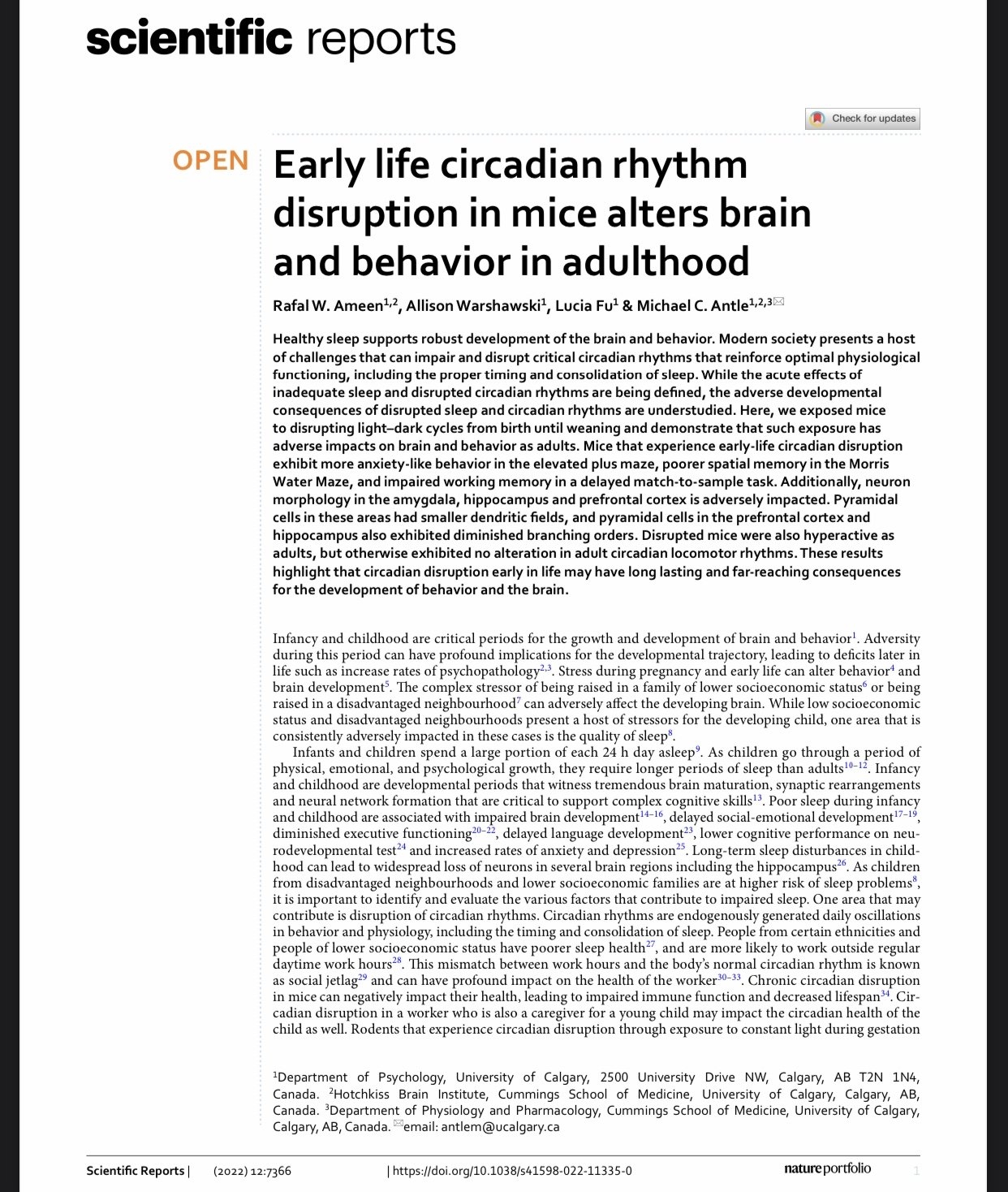
Study: Early life circadian rhythm disruption in mice alters brain and behavior in adulthood

Health begins with the light you live in. The AM light is a powerful opportunity to reset your circadian rhythms, that govern all of your body’s biological processes.

This is especially crucial during pregnancy and in the postpartum period, when development is at a sensitive stage.

Anyone can tell you it is also a stage when time flies and space just seems a perpetual chaos!

The study

Beginning on the day of birth, female mice and their litters were exposed to either a regular light-dark cycle or a disrupting light-dark cycle where dark onset was brought forward by 8 hours every second day.

Early circadian rhythm disturbances on adult spatial learning, working memory, and anxiety

The 12 mice were assessed using the Elevated Plus Maze. The disrupted animals had significantly less entries into the open arms than did the undisrupted control group. In other words, the diminished exploratory behavior is consistent with higher anxiety-like behavior in the disrupted animals.

Also, the disrupted animals spent significantly less time in the exposed arms (8.1 ± 11.0 s) compared to the controls.

The same mice were then assessed using Morris Water Maze. The disrupted animals took significantly more time to reach the platform compared to controls.

The researchers also examined neuronal complexity in the areas of the brain hippocampus, prefrontal cortex, and amygdala, respectively.

Circadian disruption during the last trimester and extending to the preschool years

The first 3 weeks postnatal in mice are comparable to a relatively wide developmental period in humans.

Postnatal days 1–10 exhibit developmental stages that correspond to the last trimester of pregnancy in humans, while brain development events in mice at postnatal days 20–21 are roughly equivalent to human brain development events observed at 2–3 years of age in children50.

This suggests that circadian disruption during the last trimester and extending to the preschool years could still have an impact on brain development. Indeed, poor sleep at 2 years of age is associated with less gray matter at 7 years of age14.

Additionally, poor sleep at 6–12 months of age17, or at 2 years of age18,19 were both predictive of delayed social-emotional development in children.

Why this is important for every mother and child

This study adds to the growing body of research we know about how circadian rhythms, including uneven sleep patterns, can affect health.

Other studies find similar effects in hyperactivity and increased anxiety.

Aside from socioeconomic status and other environmental stressors, one area that is consistently adversely impacted in these cases is the quality of sleep.

While in utero disruption led to more severe impairments in adulthood, significant deficits were still observed when circadian disruption was restricted to the postnatal period, such as was observed in the mouse study.

Infancy and childhood are critical periods for the growth and development of brain and behaviour. Adversity during this period can have profound implications for how the child develops, leading to deficits later in life such as increase rates of psychopathology.

If you are doing shift work, this could impact the circadian health of the child as well.

Sleep is a premium for any mom during pregnancy and in the precious post partum months with a newborn. Prioritising a regular, quality sleep routine is a crucial part of ensuring a healthy baby and his or her brain development, with implications far beyond just what we think we would observe.

Link to study: https://www.nature.com/articles/s41598-022-11335-0


Share if you found this study helpful.

Get in touch to make your personal health sanctuary. #morninglight #morningreset #biologicalliving #naturallight #blockbluelightatnight #circadianrhythm #sunlight

EMFs and Babies: Why You Need to Protect Your Child

Babies born today are exposed to EMFs from cellphones from the moment they’re conceived probably until the day they die.

Whether children are vulnerable to RF has been debated for the last 20 years, when children were widely exposed to mobile phones. And in everyday life, children are increasingly exposed to indoor and outdoor EMF.

As parents, we know interference with a child’s development at a fragile stage is probably unwise. We have the power to be responsible for our children’s health.

My personal opinion is to not let wireless devices around children, especially if they are below five years of age.

Given its detrimental effects on a child’s developing nervous system, some go as far as to say Mobile phones, tablets, and computer screens should be banned for children under six. Behavioural signs are clear; they make kids 'more irritable' and 'worsen their concentration and memory skills'.

But what about the biological and health impacts that begin long before any observable symptoms are seen?

In this article, we focus on the wireless radiation emitted by such devices and examine why they are so harmful to children.

What are artificial EMFs?

In modern societies that run on electricity, although we cannot totally escape the presence of artificial EMFs, or nnEMFs, we can take steps and adopt habits that will greatly reduce our exposure.

Artificial EMFs is known by different names:

  • Electro-smog

  • Electro-pollution

  • nnEMF (non native EMF)

  • Electromagnetic Fields (EMFs)

  • Electromagnetic Radiation (EMR)

There are different types of artificial EMFs, which can be broadly categorised into two types: EMF exposure is divided into two categories: extremely low frequencies (ELFs; 3–3,000 Hz), involving high-voltage transmission lines and in-house wiring; and radio frequencies (RFs; 30 kHz to 300 GHz), involving mobile phones, smart devices, base stations, WiFi, and 5G technologies.

The latter, Radio Frequency (RF) (RF-EMF), can also be called:

  • Wireless/WiFi/Bluetooth Radiation

  • Microwave Radiation


How much is too much?

There have been no pre-market studies, No long-term studies, No opportunity for an individual to opt-out of this technology, and It's everywhere.

We know children are most vulnerable to its effects.


Wireless radiation and 5G

The increased use of radiofrequency (RF) fields above 6 GHz, particularly for the 5 G mobile phone network, has given rise to public concern about any possible adverse effects to human health

Notably, wireless radiation, or pulsed EMFs, is increasing at an exponential rate as many countries speed towards 5G adoption for an Internet of Things-type society.

Such wireless radiation, are, in most cases, more active than are non-pulsed EMFs.

Artificial EMFs interfere with brain development

90% of the brain development happens in the first five years of a child’s life. Until the age of two, myelin, the fatty substance that surrounds neurons, is produced at an incredible pace . After age two, production slows but continues into adulthood. The uncompleted myelin sheaths, as well as the unprotected axons, can be easily damaged by RF-EMF. This can lead to axonal degeneration and decreased action potential speeds.

Most of the studies are animal studies on prenatal RF exposure. Prenatal exposure to 900 MHz resulted in substantial loss of granule cells [9] or a significant reduction in pyramidal neurons [10]. Mice exposed to in utero RF from cellular telephones were hyperactive and demonstrated memory impairment after birth [11]. EMFs from mobile phones changed the blood-brain barrier’s permeability and damaged neurons in the brains of exposed rats [12-14].

If you expose them to wireless pulsed nnEMF even before their brain has fully formed, this could reduce their cognitive potential. The more RF-EMF that is absorbed by the brain in a child, the more exposed the neurons

can become as demyelination progresses.

Image from: Moon JH. Health effects of electromagnetic fields on children. Clin Exp Pediatr. 2020 Nov;63(11):422-428. doi: 10.3345/cep.2019.01494. Epub 2020 May 26. PMID: 32683815; PMCID: PMC7642138.


Children are more vulnerable to EMFs

The nervous systems of children are more vulnerable to the effects of electromagnetic waves than adults. The developing nervous system is more conductive and absorbs more electromagnetic energies than those of adults [4].

The younger the brain is, the more damage from the nnEMF. Children do not have a fully developed myelin sheath—a layer of fat that protects the brain.

The conductivity of children is higher due to higher moisture and ionic content than adults

Their bodies are more likely to become an antenna for these wireless EMFs.

Children have thinner skulls

The skull thickness of adults is approximately 2 mm. However, the skull thickness of a 5-year-old child is approximately 0.5 mm and 1 mm in 10 years [39]. Therefore, radiation penetration is larger in children than in adults [39,40].

As a child’s head diameter is smaller, the energy-absorbing “hot spots,” the most sensitive parts of RF, are more pronounced [41]. Your child brain absorbs more radio frequencies than yours, whether from Bluetooth, WiFi, Cellphone, Dish TV, Smart meters...

Children will likely have a higher cumulative exposure

EMF effects are often cumulative; and EMFs may impact young people more than adults.[3]

In 2000, the “Stewart report” by the UK Independent Expert Group on Mobile Phones declared that children may be more vulnerable to EMF than any other age groups [4,36]. They stated that “children are exposed to electromagnetic waves over a longer life time than adults and their nervous systems are in the process of development. As the conductivity of the children is higher due to higher moisture and ionic content than adults, and more than adults, children’s head absorbs a lot of RF energy” (Fig 3) [4].


Exposed in utero

In today’s world, most children are exposed to various manmade electromagnetic fields. Not only so in the womb, babies are born into environments swimming in electrosmog.

Common home sources are: extremely low-frequency EMFs are generated by electricity, various home appliances, in-house wiring, and outside high-voltage lines. Radio frequency EMFs waves are generated by mobile phones, smart devices, WiFi, base stations, and other devices.

Did you know? More EMFs are absorbed with the use of appliances that are close to the body (e.g., hair dryers, bidets, massagers, and electric blankets). The general recommendation is that electrical appliances should be used at least 30 cm away from the body.

A recognised carcinogen

The WHO maintains that “more evidence” is required to assess if children were more vulnerable to EMF because very few studies assessed this topic [29]. At the same time, the WHO recommends general measures such as reducing personal EMF exposure. They also recommend minimizing EMF exposure in schools, kindergartens, and any locations where children remain for a substantial part of the day.

Use the cautionary principle for our children

Children are more vulnerable to the effects of electromagnetic waves than those of adults.

While debate continues around the effects of EMFs on children’s health, precautionary principles should be followed for children and the exposure to EMFs among children should be minimized.


resources & references

[3] Pall ML. Wi-Fi is an important threat to human health. Environ Res. 2018 Jul;164:405-416. doi: 10.1016/j.envres.2018.01.035. Epub 2018 Mar 21. PMID: 29573716. https://pubmed.ncbi.nlm.nih.gov/29573716/

4. Stewart W. Mobile phones and health, report of independent expert group on mobile phones. Chilton (UK): IEGMP Secretariat; 2000. [Google Scholar] [Ref list]

Jin-Hwa Moon. Health effects of electromagnetic fields on children. https://www.ncbi.nlm.nih.gov/pmc/articles/PMC7642138/#b39-cep-2019-01494

39. Warille AA, Onger ME, Turkmen AP, Deniz ÖG, Altun G, Yurt KK, et al. Controversies on electromagnetic field exposure and the nervous systems of children. Histol Histopathol. 2016;31:461–8.[PubMed] [Google Scholar]

40. Wiart J, Hadjem A, Gadi N, Bloch I, Wong MF, Pradier A, et al. Modeling of RF head exposure in children. Bioelectromagnetics. 2005;Suppl 7:S19–30.[PubMed] [Google Scholar]

39. Warille AA, Onger ME, Turkmen AP, Deniz ÖG, Altun G, Yurt KK, et al. Controversies on electromagnetic field exposure and the nervous systems of children. Histol Histopathol. 2016;31:461–8.[PubMed] [Google Scholar]

40. Wiart J, Hadjem A, Gadi N, Bloch I, Wong MF, Pradier A, et al. Modeling of RF head exposure in children. Bioelectromagnetics. 2005;Suppl 7:S19–30.[PubMed] [Google Scholar]

41. Kritikos HN, Schwan HP. Hot spots generated in conducting spheres by electromagnetic waves and biological implications. IEEE Trans Biomed Eng. 1972;19:53–8. [PubMed] [Google Scholar]