Three Immediate Ways to Lower Nursery EMFs Tonight (Without Buying Anything)

I spent a long time learning about EMFs before I got my own home in shape. Along the way, I learnt about EMFs sources inside the house vs. external threats, and more EMF products than I ever thought could exist in a fringe market.

But here’s the truth: The market is fringe no more. EMFs is a number one threat facing our future generations.

And you don’t have to break the bank to protect baby.

1. Apply the Rule of Distance

The Problem: Electromagnetic fields (EMFs) drop off significantly with distance. For example, doubling the distance reduces the field strength to about 25% of its original value.

A wireless baby monitor or smart device sitting right next to the crib exposes a newborn's thin skull to peak radiation levels.

The Free Fix: Stand further away from appliances when you are using them. Move all appliances such as electrical cords, baby monitors, white noise machines and cameras at least 6 to 10 feet away from the crib.

You still get the video and audio feeds, but the radiation intensity drops with distance before reaching your baby's body.

2. Hardwire What You Can (And Turn Off the Rest)

The Problem: Wi-Fi routers and connected smart appliances constantly ping signals back and forth, 24 hours a day, filling the entire room with invisible cellular stress.

The Free Fix: Go into your phone settings and turn off Bluetooth and Wi-Fi on any devices inside the room when they aren't actively needed. If your router is near the nursery, manually turn it completely off at the wall plug right before you go to sleep.

3. Clear the Wall "Hot Zones"The Problem: EMF radiation passes directly through standard drywall.

Even across concrete walls, EMFs can still pass through them. If the nursery crib is pushed up against a wall, and a major appliance, television or smart meter is plugged into the exact opposite side of that wall in the next room, your baby is sleeping in a magnetic field hot zone.

The Free Fix: Look at what is positioned on the other side of the nursery walls. If there is a TV, computer desk, or refrigerator back-to-back with the crib, simply rearrange the nursery layout. Move the crib to an internal wall that has nothing plugged into either side of it.

Ready for the next step?

A nursery is your baby’s safe space. If you want to completely audit your home, map hidden EMF sources and clear out toxic pollutio, let's work together.

I can help you build the ultimate low-tox sanctuary through:

The Building Biology Home Blueprint Course ($300): A complete, self-paced video guide to prepping a certified non-toxic home.

A Personalised Home Assessment: Book a 1:1 strategy session with me tailored exactly to your space.

This is what you can do immediately. To eliminate sources of EMFs in your nursery, read this.

Common Sources of EMFs in Your Children’s Room (Free Guide for Parents)

“What if the safest place in your home for your child is the most harmful?”

In this guide, you will find common sources of EMFs in children’s rooms and nurseries.

I write not only what these sources are, but why some might be more harmful than others. I also share the actions you can take to reduce your children’s exposure to these man-made EMFs.

As a mother and building biologist, my aim is to remove and eliminate toxic sources completely to reduce the body burden on our children, especially during critical developmental phases.

These are changes you can make immediately. For a peace of mind and true health for your child and yourself.

To your space.

Common Sources of EMFs

You probably already know about wireless devices and that power line and cell antenna down the road.

But artificial electromagnetic fields are everywhere within your own home. These devices in the bedroom emit electromagnetic fields that could affect your child.

Your child’s optimal development depends on critical growth stages. Your child’s bedroom deserves the lowest possible EMF levels.

1.Wireless baby monitors

Baby monitors are marketed as a mama’s must-haves. These fancy gadgets let you check on your baby on your smartphone, from anywhere.

Some include features like night vision, alerts, temperature monitoring, and two-way talk. Baby monitors can be Wi-Fi, radio (no internet), audio, and app-based.

But they send audio, and sometimes video, from a transmitter near your baby to a receiver using radio signals (typically 2.4 GHz). Your baby or child is in these near radio frequency fields for 10-12 hours a day, while they are sleeping, if not longer.

Baby monitors promise “connectedness”, but you’re relying on wireless radiation to make the connection, adding to EMF pollution in your child’s room.

Eliminate artificial EMFs in your child’s bedroom: Hardwire your baby monitor instead.

2. Wireless security cameras

Like baby monitors, these emit RF fields around your children while they sleep.

Eliminate artificial EMFs in your child’s bedroom: Hardwire any security cameras.

3. Wi-Fi

Wi-Fi routers emit EMFs constantly, even if no one is using the internet.

Removing Wi-Fi in the bedroom is fundamental to creating calm and safe environment for a night’s sleep. Eliminating Wi-Fi during the day, too, is a great way to reduce your newborn’s EMF exposure.

Eliminate artificial EMFs in your child’s bedroom: Hardwire Wi-Fi. Remove the router from your bedroom.

4. Fans

The motors in the fans put out sizeable magnetic fields as well as electric fields.

Magnetic fields are how fans work. The electric current flows through the motor's coils, generating a magnetic field interacting with another magnetic field, creating a force that causes the motor's shaft to rotate. This pulls the rotor around via magnetic attraction.

Magnetic fields do drop off with increasing distance, so make sure to put as much distane as possible between the fan and where your child is sleeping.

Eliminate artificial EMFs in your child’s bedroom: Use a meter such as a Trifield that has both a gaussmeter (for magnetic fields) and an electric field meter.

5. Adjustable tables

Adjustable tables are powered by pretty strong electrical motors. They rely on a transformer in order to convert the power.

Eliminate artificial EMFs in your child’s bedroom: If you must use an adjustable table, one workaround is to cut the power to the table when you are not using it.

6. Dimmer switches

You want to control the level of lighting in your child’s room, but dimmer switches emit 10 to 50 times more EMF than regular on/off switches due to their electronic components.

By design, dimmer switches interrupt electrical current by “chopping” the electrical waveform to lower light intensity.

Some turn the light bulb circuit on and off as many as 120 times a second. This puts out high-frequency voltage transients into your home wiring that radiate into the room as well as other rooms!

Dimmer switches have been measured to put out dirty electricity even when they turned “fully on”.

Eliminate artificial EMFs in your child’s bedroom: Replace dimmer switches with standard on/off switches to eliminate a direct source of EMF pollution in your home. Avoid smart switches.

7. Bedside Clocks

Often emit low-frequency EMFs. Many clocks produce measurable magnetic or electric field radiation, as well as circadian-disrupting blue light. These are up to 20 times above recommended “safe” levels at the bed.

Some even have Wi-Fi, or Bluetooth functions built in.

Battery-powered models put out far less EMFs than plug-in digital clocks. But 100% EMF-free alarm clocks use no electricity or batteries. Only mechanical wind-up clocks are EMF-free.

Eliminate artificial EMFs in your child’s bedroom: Choose analog alarm clocks or even mechanical wind-up clocks.

8. Electrical wiring

Currents along wiring emit low-frequency EMFs, even when devices are turned off. So long as you’re in a house, to the extent of the wiring, you are likely surrounded by such EMFs.

Eliminate artificial EMFs in your child’s bedroom: Use a meter such as a Trifield that has both a gaussmeter (for magnetic fields) and an electric field meter.

9. Smart toys

You can find RF chips in all sorts of things these days, including in toys. The idea is that you can these toys with phones and also communicate with other smart toys in the product line.

Children should not be playing with phones. You don’t want smart toys next to children, especially when they sleeping, as the toys may be accidentally turned on.

Eliminate artificial EMFs in your child’s bedroom: The safest (and easiest) thing to do is to remove these toys. How do you know if you have a smart toy? Batteries are a giveaway, because RF chipped toys need them to operate.

10. Baby rockers

Like baby monitrs, these devices can come with smart features, multiple motions, and parent-friendly designs—anything to promise your child’s sweet sleep.

However, the rocking mechanism and elevated electric fields from the wiring create high levels of EMFs.

11. Cell phones

Wireless mobile devices emit high levels of EMF whether you are using them or having them plugged in and charging near baby areas.

12. Smart home devices

Do you have these? Smart appliances such as humidifiers, sound machines, night lights, voice assistants, smart thermostats, and connected baby products…

Eliminate artificial EMFs in your child’s bedroom: Hardwire devices, if you must use them in the room.

13. Laptops

Work-from-home has become normal. You might keep your laptop in the bedroom.

I only use mine with I will only use it with an ethernet cable. But even with Wi-Fi or Bluetooth turned off, I’ve measured other high EMFs.

Eliminate artificial EMFs in your child’s bedroom: Hardwire devices, if you must use them in the room.

14. Spring mattresses

Technically, spring mattresses are not emitting EMFs by themselves. However, they attract ambient magnetic fields and electric fields where you’re sleeping.

They’re especially a concern if you are very sensitive. Or if you are a child more vulnterable to the effects of EMF radiation. It is hard to quantify or have an exact number on how much radiation spring mattress can emit, due to the fluctuations in the environment. Suffice to say, given how much time we spend on a mattress, you want to take this into consideration.

15. Ethernet cables

Ethernet cables enable us to use the Internet without exposure to Wi-Fi. But even shielded cables can measure high in electric fields.

Eliminate artificial EMFs in your child’s bedroom: Keep them at least 1 or 2 feet away from your body.

More about EMFs

Congratulations on going through the list.

You can see how you do not need major renovations or expensive tools to reduce EMFs in your child’s bedroom.

By now you are becoming aware of the major types of EMFs. Here is an introduction to EMF radiation.

Measuring EMF Levels in Your Child’s Bedroom

If you want to go a step further, a Building Biologist will assess your whole space. The key areas include:

  1. Crib measurements. Measure every area of the crib at mattress level. Pay attention to the head area where your baby’s head will lie. Take multiple readings throughout the day.

  2. Changing area assessment. Measure EMF levels at your changing station, especially if it is near electrical outlets or wireless devices.

  3. Feeding locations. Where do you sit and feed for hours? Check your primary feeding areas, whether it is a nursing chair or where you sit and breastfeed, prepare milk, and/or pump breastmilk.

  4. Play area evaluation. Babies grow so fast, and they’re usually rolling and crawling by six months. I measure EMF levels to help you identity optimal areas for tummy time and play activities.



Do you want to know more? I expand on these in my ebook “The Building Biology Home: Guide to a Calm and Safe Bedroom”. You’ll learn:

  • Why building EMF-awareness habits is crucial for your children’s health

  • The science on EMFs, optimal development, and children’s critical growth stages

  • The daily routines to start now to protect against EMFs

  • Pro tips for maximum effectiveness, including EMF protection products

  • Frequently asked questions about EMFs and children

  • How-To-Guide: Use an EMF meter to measure electric fields, magnetic fields, and radiofrequency radiation in your nursery

This is your essential EMF protection guide for mothers and fathers seeking to create a safe and optimal space for their children. I’m a mother and I understand your concerns. You will not find fear-mongering or a sales pitch for gadgets.

Every tip is something you can understand and implement today. Every strategy effectively reduces exposure while helping you become a better parent during these precious early years.


The Complete Guide: Are You Sensitive to Electromagnetic Fields?

UPDATED 15/4/2026

  • What is Electromagnetic Sensitivity or EHS?

  • My EHS Story

  • What Causes Electromagnetic Hypersensitivity or EHS?

  • Who Is Most Electrosensitive?


What are EMFs?

EMFs, or electromagnetic fields, are invisible areas of energy. Anything that is electrically charged can generate EMFs, everything from the sun to your cell phone.

But we are talking about manmade EMFs here, often associated with aforementioned cell phone, as well as electrical power.

In my assessments, I cover four specific types of this artificial radiation.

We can also think of EMFs as low frequency and high frequency. The low-frequency EMFs come from electrical sources such as power lines, electrical wiring, and appliances such as your washing machine, air-con, and refrigerator. On the other hand, high-frequency EMFs are emitted by wireless devices, including your cell phone, iPad, and Wi-Fi router.

In this article, I focus on the symptoms of EMF sensitivity. Once we learn more about what EMFs are, their sources (ubiquitous and probably in your own hand right now), and their potential effects, we understand more about our health.

What is Electromagnetic Sensitivity or EHS?

This is the term given to people who report health issues asociated with EMFs, often to debilitating effects.

These Electromagnetic Fields (EMFs) created by devices like smartphones, WiFi routers, and home appliances in the form of wireless radiation. They may be other forms of EMFs such as magnetic and electrical fields created by other appliances and structures such as power lines.

These energy fields are invisible and can affect our health in ways we may not immediately recognise.

Symptoms of EHS

To understand By now you might be familiar with the common symptoms of EHS: headaches, fatigue, sleep disturbances, skin irritation, dizziness, and difficulty concentrating.

But aren’t these common health issues anyway?

Here is how to tell if your symptoms are related to EMFs.

1—Headaches

Our brain is a massive energy hog. Even mild thirst or when your body is dehydrated (doesn't get the fluids it needs) can cause headaches.

If your headaches are frequent and/or severe, often worsening with increased EMF exposure, they are likely related to EMFs..

2—Fatigue

If you wake up still feeling tired, you might be sensitive to EMFs, because they disrupt circadian rhythms by interfering with melatonin production and altering sleep patterns.

When you are struggling with EHS, you feel persistent tiredness that does not improve with rest.

3—Sleep Disturbances

Relatedly, you find it difficult to go to sleep, or even stay asleep. You wake at night, even though you’ve the best blackout curtains. Such difficulty falling asleep or staying asleep, often linked to the presence of electronic devices.

4—Skin Irritation

The skin is related to our gut, which is why food allergies manifest as eczema, psoriasis, etc. EMFs, too, can trigger the skin directly. Symptoms may include redness, tingling, or burning sensations on the skin.

5—Dizziness

You get a sense of sensation of lightheadedness or imbalance, particularly in environments with high EMF exposure. You might actually get dizzy to the point of fainting.

6—Difficulty Concentrating

You might have trouble focusing or maintaining attention, which can affect daily activities.

We talk about generation brain rot. But it is no coincidence that our youth are the first ones growing up in a digital era.

Gen Z grew up in a screen-saturated world. Compared to Gen Z, many Generation Alpha children (born during 2013) were given iPads around the age of 2 to 4, growing up with a tablet already in front of them.

The science is clear on how screen overuse leads to concentration problems

7—Mood Swings

It is not right to feel your emotions swing. You might feel mood swings with rapid changes in mood, including irritability or anxiety, even anger.

8—Muscle Pain

This is generalized pain or discomfort in muscles, without any other cause. You have not recently hurt yourself. You’ve not been working out too much, etc. Sometimes the pain resembles fibromyalgia.

9—Heart Palpitations

You might feel noticeable changes in heart rhythm, which may occur in high EMF areas.

10—Sensitivity to Noise

You develop a sensitivity to sounds, which you have never had before. This can be any sound, whether crowded malls or people talking normally nearby, which can exacerbate feelings of discomfort.

There are many other symptoms. These are the EHS, Electromagnetic Sensitivity, or EMF exposure are confirmed in the research below:

  • Headaches [6]

  • Lack of Appetite [1]

  • Digestion problems [2]

  • Anxiety [1,5]

  • Sleep Difficulties [1,2,3]

  • Unstable moods and Bursts of anger Due to Poor Sleep [1]

  • Depression [1]

  • Fatigue [1]

  • Lack Of Concentration [1,6]

  • Irritability [1]

  • Memory problems [1,6]

  • Visual problems- blurry vision [1,2]

  • Vertigo or Dizziness [1,2]

  • Tinnitus or Ringin In The Ears [2,3,6]

  • Abdominal Swelling [2]

  • Burning pain in hands, shoulders, legs and feet [2]

  • Itch [4]

  • Edema, swelling, bloating [2,4]

  • Chills [2]

  • Photosensitivity

  • Tachycardia [2,5]

  • Heart Palpitations [2,4,5]

  • Difficulty Breathing [2]

  • Cystitis [2]

  • Skin Rashes [1,4]

  • Heightened sensitivity to touch, smells, chemicals, light, and noise [6]

  • Weakness [6]

These symptoms can occur immediately, minutes or hours later, or over months or years.

When exposure continues, you develop a higher risk of brain and gut issues, reduced cognition, and cancer.

My EHS Story

For example, I lived with near-daily bouts of dizziness, headaches, and even migraines. When I got my first iPad, I developed heart palpitations, although I still did not put two and two together.

When I got pregnant, these symptoms magnified seemingly overnight. Some grew louder over subsequent weeks. Other symptoms emerged: extreme fatigue, difficulty concentrating, digestive issues. The doctors assured me that most pregnant women feel awful.

But my symptoms did not alleviate throughout pregnancy, nor after giving birth. They seemed to increase or decrease inexplicably. Until I connected them to my environment, especially my home and my workspace.

What Causes Electromagnetic Hypersensitivity or EHS?

These sources can be outdoors, but are more often than not found indoors in your own home.

Indoor sources:

  • Cellphones

  • Wi-Fi

  • Smart meters

  • Microwave oven

  • Alarm systems (i.e., motion-detectors)

  • LED lights, dimmers (emit unclean electricity)

  • Cordless phones

  • Washing machines

  • Electric heating located under your floors

  • Plasma TV monitors

  • Any other “Smart” appliances

  • Electric Blanket

  • Wired Clock Radio

Outdoor sources:

  • power lines

  • cellphone towers

Electric vehicles are another source of EMFs. You could argue that they an indoor source since they affect you sitting inside.

Who Is Most Electrosensitive?

Children are more susceptible to the potential effects of EMFs due to their developing bodies and brains. Their skull is thinner, their brain contains more water and fat, and their nervous system is still developing.

In fact, studies have shown that kids can absorb twice as much radiation in the head, and ten times as much in the bone marrow, compared to adults.

Children are also growing up in a wireless radiation soup. Science has shown how EMFs weaken the blood-brain barrier, alter gene expression, and interfere with hormone production.

This is why EMF awareness is crucial to secure our health today and that of future generations. This is why EMF awareness IS protection for children.

Simple strategies are:

  • limiting screen time

  • keeping wireless devices out of bedrooms

  • using wired devices whenever possible

These to help protect your children from some excess EMF exposure.

But children need protection from the environmental stress caused by invisible EMF fields. This means rethinking what’s in your home and what’s near your child 24/7. This is why I include other components of a calm safe home in an EMF-focused consultation; they go hand in hand.

On top of that, EMFs may be invisible but we can talk about it. Educate your children about the potential risks of extended electronics usage and encourage safe technology use.

Given the proliferation of digital infrastructure and the very real ways we are seeing degenerative health in digital lifestyles, I am so glad to more awareness is growing about this topic.

But we can do more and change the one place that we spend our lives and create most of our core memories with—the home.

Building Biology Home: Creating the Home to Protect Our Families
If you are serious about raising healthier kids in a wireless world, you are in the right place.

If you want to learn more about EMFs and building biology principles to create a calm home, subscribe to my newsletter. I share how to create a calm with practical truth, not fear.

Get started now with my EMF Bootcamp to eliminate, once and for all, the most common toxin in your space. In this bootcamp, you will understand the importance, types of EMFs, and effective strategies for your defense against EMF exposure.

Do you want an EMF-safe home? Work with me.


References and resources about EHS symptoms:

[1] Gómez-Perretta cell radiation exposure stud
[2] Piras et.al. Fibromyalgia and EHS Study 
[3] Bhat, Kumar Gupta Study of the Effects of Radiations Study of the Effects of Radiations  
[4] Johannson Immune system and electromagnetic fields study             
[5] Magda Havas Wireless Radiation and Autotomic system study 
[6] Gunnar Heuser Functional MRI and EHS Study


What Are EMFs? 7 Things You Need to Know as a Mother

You probably hear about EMFs and its associated risks in the devices, content, and habits that we have, but what exactly does it mean? And what does it mean if you have children or are planning for a family?

In this article, you’ll learn what is EMFs and how they’re negatively affecting the health of children, in particular concerns around fertility, conception, birth and all through the crucial years of child development.

What are EMFs?

EMFs are invisible and completely beyond most people’s awareness. However, some people can actually feel them. Especially those that are manmade (non-native electromagnetic radiation).

The Electromagnetic Spectrum

The simplest way to understand how important EMFs are to our health – is by learning about the electromagnetic spectrum.

contains the entire range of all electromagnetic radiation. It also shows the field’s approximate frequency – which relates to its wavelength.

At the absolute lowest frequencies in the hertz range, we see the largest wavelengths. These are the size of several thousand miles! The lowest of frequency fields includes the Earth’s Schumann Resonance, which is also very healing for us when we are grounded in Nature to its energy.

The higher in frequency, the field gains more energy, and also reduces in wavelength. (That’s why wireless radiation is often called pulse radiation to describe its very high energy field.) In fact, at the frequency of Wi-Fi, your body is being exposed to 2.4 or 5 billion pulsations per second. Compare that to the natural Schumann Resonance, which has just 8 gentle cycles per second.

EMFs may be triggering your child’s hungries

In healthy participants and compared with no exposure, 50-minute cell phone exposure was associated with increased brain glucose metabolism in the region closest to the antenna. Link to the study: https://jamanetwork.com/journals/jama/fullarticle/645813

Light can cause breast cancer

75 studies and articles showing effects of EMFs and the initiation and promotion of breast cancer.

https://emfrefugee.blogspot.com/2019/06/emfs-and-breast-cancer.html?m=1

2008 – Austria – Cell Phone Towers and CancerA study by Austrian Dr. Gerd Oberfeld (EMFacts 2008) showed a 23-fold increase in breast cancer and a 121-fold increase in brain tumors for those who lived with 200 meters of a cell phone base station for five years or longer! http://www.verwaltung.steiermark.at/cms/ziel/21212/DE/

EMFs may be harming your chances of conception

There’s enough compelling evidence to show how higher levels of exposure can reduce sperm quality in men.

It can also increase miscarriage risk in women. Two miscarriage studies, conducted by Kaiser Permanente and funded by the National Institute of Environmental Health Sciences, are particularly interesting because they're some of the only ones to date that actually measured EMF exposure in subjects using a magnetic field monitoring device.

"We took [913 pregnant women] and asked them to wear the monitor for the duration of their pregnancy. Studies right now aren't using the meters because most of them are focusing on cancer. [But] Cancer can take 20 years to develop—you can't measure your exposure from 20 years ago, so in those cases, you just ask how much the person uses their cell phone." — eproductive epidemiologist De-Kun Li, MD, PhD, the principle investigator on both studies (one published in 2002, one published in 2017).

Singapore breast cancer statistics

What does your bedtime routine have to do with your breast cancer risk?

-

Breast cancer is the most common malignancy among women anywhere you're from. In Singapore,

Researchers looked at how short wavelength visible light in the blue region emitted from digital screens TANKS this crucial process.

also examined different levels of radiofrequency electromagnetic fields (RF-EMFs) such as cellular phones (29-40), mobile base stations(4142), Wi-Fi routers

We have shown that both the blue light and RF-EMFs generated by mobile phones are linked to the disruption of the circadian rhythm in people who use their phones at night.

women who carry mutated BRCA1 or BRCA2, or women with family history of breast cancer should avoid using their smartphones, tablets and laptops at night.

Why bother with a sleep sanctuary if any will do?

Protecting your sleep/wake cycle is paramount to prevent cancer. Melatonin, the hormone dominant at night, is your ANTI-CANCER hormone. "has been shown to produce strong anti-cancer actions and also promotes sleep."

All mice were kept in the light for 12 hours each day. One group of three mice was in the dark the other 12 hours, which helped them produce high levels of endogenous melatonin. Another group spent 12 hours in light followed by 12 hours in dim light at night, which suppresses their nocturnal melatonin production. The dim light was 0.2 lux, which is less than a night-light or a display light from a cell phone

And the number disruptive to your

Women are more sensitive to melatonin disruptions.

BOTH the blue light and RF-EMFs generated by mobile phones are linked to the disruption of the circadian rhythm in people who use their phones at night.

Your breastmilk can be changed by your light enviroment

Human breast milk is more than a meal – it’s also a clock, providing time-of-day information to infants.

https://theconversation.com/human-breast-milk-may-help-babies-tell-time-via-circadian-signals-from-mom-118492?fbclid=IwAR2kplJ4RVUugLqqc7poMbCmZGYCnZvcxwDFXzmE_URmkbTS4ExjArOIZjo

Children are especially susceptible

Children are more vulnerable than adults to the effects of EMF (electromagnetic frequencies or fields) for a number of reasons, and most are submerged in an electrosmog soup all day, every day. What are the risks?

In 2016, the National Toxicology Program released the results from the largest cell phone study ever performed on the link between nonionizing radiation and cancer. Rats exposed to the frequency of radiation emitted by cell phones developed two kinds of tumors: gliomas in the brain and schwannomas in the heart. These results align with several observational studies finding links to the same types of tumors in humans - plus acoustic neuromas and meningiomas.

  • Sleep deprivation

  • Low energy, “brain fog”, mommy brain

  • Mood issues, such as anxiety, depression, aggression and impulsivity

  • Increased stress

  • Affect sleep/wake cycles in babies through breastfeeding

  • Developmental issues (especially in young kids)

  • Dry-eye disease

  • Decreased hand-eye coordination

  • Reduced ability to form social connections and relationships

  • Reduced executive function

In 2010, Powe et al. reported that among 25 Boston-area women,  mothers of sons produced ~25% higher energy density in milk than mothers of daughters. More recently, Fujita and colleagues (2012) revealed sex-biases in the milk fat concentration among 72 women in rural Kenya. On average, mothers of sons produced significantly higher fat concentrations in milk.

Children are also sensitive to their environment

Some people are "exquisitely sensitive" to places where EMFs are present. Some literally cannot be in certain places because of the Wi-Fi there—they end up with fatigue and headaches and ringing in the ears and a sense of brain fog to the extent that it may affect thinking and speech patterns.

I had a glimpse of this as a child that worsened as a teenager until it hit a peak when I was working fulltime. It took me until I was into my 30s to understand where all these symptoms were coming from.

The thing is, at that time I had no idea what was going and kept going, kept struggling despite the bouts of malaise that would hit me. It takes time for children to learn how to express their bodily aches in calm ways for our adult ways; before then, it often manifests as temper tantrums, general fatigue and “laziness”, and spectrum-type disorders.

Brain development in children

A child’s hippocampus and hypothalamus absorb 1.6 to 3.1 more MWR than an adult’s, and his cerebellum absorbs 2.5 times more[6][7]

Resources and references:

  1. [6] Christ, Andreas, Marie-Christine Gosselin, Maria Christopoulou, Sven Kühn, and Niels Kuster. "Age-dependent Tissue-specific Exposure of Cell Phone Users." Physics in Medicine and Biology55, no. 7 (2010): 1767-783. doi:10.1088/0031-9155/55/7/001

  2. [7] Gandhi, Om P., L. Lloyd Morgan, Alvaro Augusto De Salles, Yueh-Ying Han, Ronald B. Herberman, and Devra Lee Davis. "Exposure Limits: The Underestimation of Absorbed Cell Phone Radiation, Especially in Children." Electromagnetic Biology and Medicine31, no. 1 (2011): 34-51. doi:10.3109/15368378.2011.622827.

  3. the Agency has issued opinions on the health effects of 5G deployment, high-voltage lines, body scanners and light-emitting diodes.

  4. READ MORE about the link between night time light exposure and breast cancer here ((Melaniechua.com)).

  5. https://www.ncbi.nlm.nih.gov/pmc/articles/PMC5811748/?fbclid=IwAR3nAtsjrYTSCzDy5S7ayvcRmEgs4QZNyTBkhe6qoLEgTTkAyaWC7wOue0U#!po=1.51515

  6. https://m.medicalxpress.com/news/2019-03-breast-cancer-likelier-bone-nighttime.html?fbclid=IwAR114v839lOxffTGnuuWVPfsVcMWaRf9fntJsxIi0NW7f-Shm_en3-OLE9M

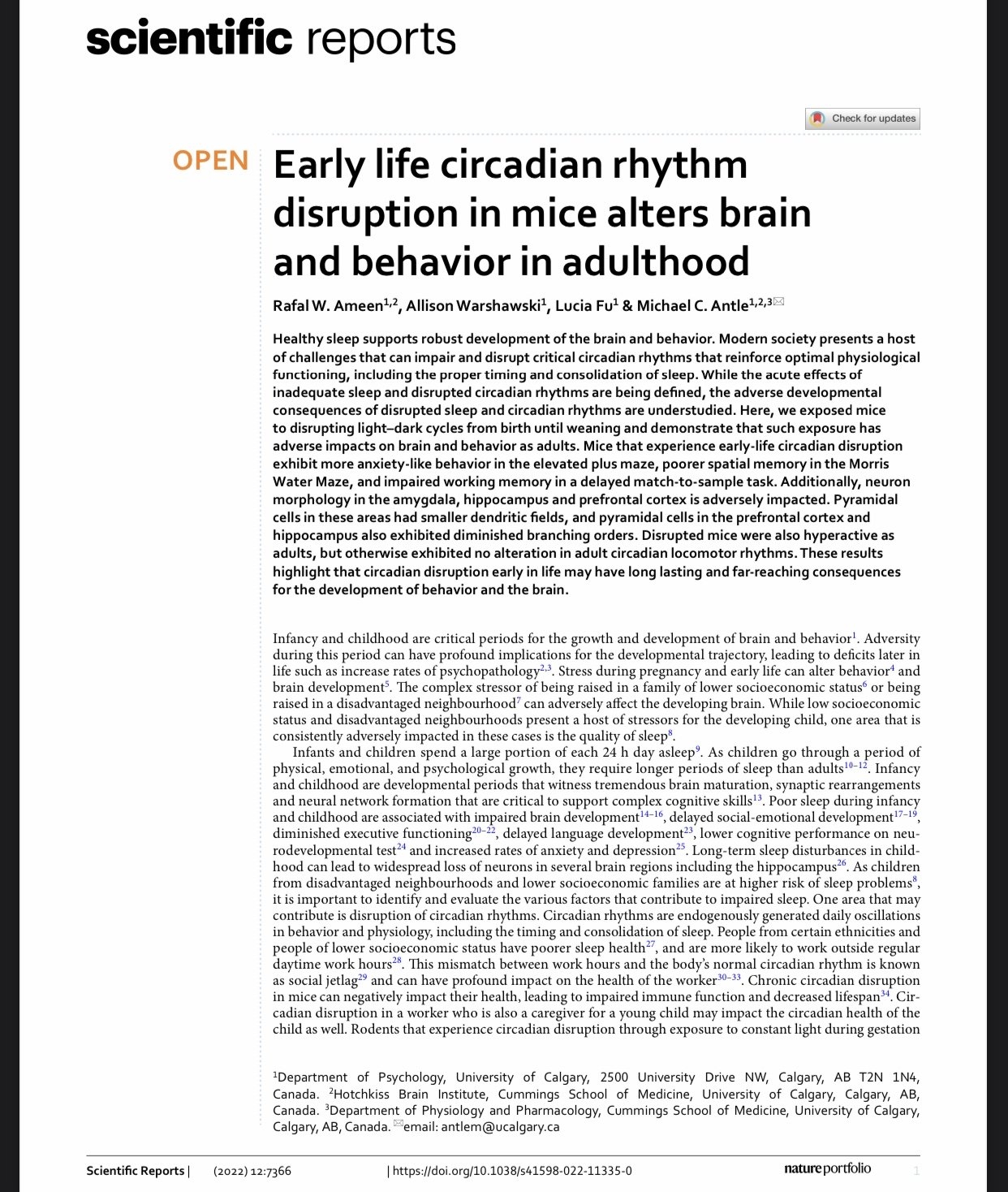
Study: Early life circadian rhythm disruption in mice alters brain and behavior in adulthood

Health begins with the light you live in. The AM light is a powerful opportunity to reset your circadian rhythms, that govern all of your body’s biological processes.

This is especially crucial during pregnancy and in the postpartum period, when development is at a sensitive stage.

Anyone can tell you it is also a stage when time flies and space just seems a perpetual chaos!

The study

Beginning on the day of birth, female mice and their litters were exposed to either a regular light-dark cycle or a disrupting light-dark cycle where dark onset was brought forward by 8 hours every second day.

Early circadian rhythm disturbances on adult spatial learning, working memory, and anxiety

The 12 mice were assessed using the Elevated Plus Maze. The disrupted animals had significantly less entries into the open arms than did the undisrupted control group. In other words, the diminished exploratory behavior is consistent with higher anxiety-like behavior in the disrupted animals.

Also, the disrupted animals spent significantly less time in the exposed arms (8.1 ± 11.0 s) compared to the controls.

The same mice were then assessed using Morris Water Maze. The disrupted animals took significantly more time to reach the platform compared to controls.

The researchers also examined neuronal complexity in the areas of the brain hippocampus, prefrontal cortex, and amygdala, respectively.

Circadian disruption during the last trimester and extending to the preschool years

The first 3 weeks postnatal in mice are comparable to a relatively wide developmental period in humans.

Postnatal days 1–10 exhibit developmental stages that correspond to the last trimester of pregnancy in humans, while brain development events in mice at postnatal days 20–21 are roughly equivalent to human brain development events observed at 2–3 years of age in children50.

This suggests that circadian disruption during the last trimester and extending to the preschool years could still have an impact on brain development. Indeed, poor sleep at 2 years of age is associated with less gray matter at 7 years of age14.

Additionally, poor sleep at 6–12 months of age17, or at 2 years of age18,19 were both predictive of delayed social-emotional development in children.

Why this is important for every mother and child

This study adds to the growing body of research we know about how circadian rhythms, including uneven sleep patterns, can affect health.

Other studies find similar effects in hyperactivity and increased anxiety.

Aside from socioeconomic status and other environmental stressors, one area that is consistently adversely impacted in these cases is the quality of sleep.

While in utero disruption led to more severe impairments in adulthood, significant deficits were still observed when circadian disruption was restricted to the postnatal period, such as was observed in the mouse study.

Infancy and childhood are critical periods for the growth and development of brain and behaviour. Adversity during this period can have profound implications for how the child develops, leading to deficits later in life such as increase rates of psychopathology.

If you are doing shift work, this could impact the circadian health of the child as well.

Sleep is a premium for any mom during pregnancy and in the precious post partum months with a newborn. Prioritising a regular, quality sleep routine is a crucial part of ensuring a healthy baby and his or her brain development, with implications far beyond just what we think we would observe.

Link to study: https://www.nature.com/articles/s41598-022-11335-0


Share if you found this study helpful.

Get in touch to make your personal health sanctuary. #morninglight #morningreset #biologicalliving #naturallight #blockbluelightatnight #circadianrhythm #sunlight

Electromagnetic Hypersensitivity Syndrome (EHS): Why Is It So Common & What Can You Do About It?

Updated 4 August 2024.

Electro-sensitivity symptoms are becoming commonplace—reflecting the increasing digitisation of our lifestyles and digital infrastructure with 5G and the IoT. What’s causing this? Learn more, plus find out how to advocate for yourself.

First, what is Electromagnetic Hyper Sensitivity (EHS)?

EHS is also called Electromagnetic Sensitivity, electro-hypersensitivity, electro-sensitivity, electrical sensitivity (ES) and “Idiopathic environmental intolerance attributed to electromagnetic fields (IEI-EMF)”.

EMF is an "electrostatic" field or electromagnetic field that comes off any electronic device that emits energy, frequencies, radiation, or field of energy of any type.

Back in the 1970s, EHS was known as “microwave syndrome", clinically characterised by the a wide spectrum of symptoms affecting various organs, typically including central nervous system symptoms. The vast majority of electrohypersensitive (EHS) patients complain about headaches on contact with an electromagnetic source.

A report from the former Soviet Union described it as “microwave syndrome”[r]. The Soviet military recognised early on the possible side-effects from radar and radio radiation. Medical diagnoses frequently noted various symptoms typically including central nervous system symptoms, that occur following the patient's acute or chronic exposure to electromagnetic fields.

Statements on EHS by health organisation

Austria is the only country with a written suggestion to guidelines on the diagnosis and treatment of EMF-related health problems. Apart from this, EHS is not recognised as a specific diagnosis in the rest of the world.

However, institutions such as the WHO, the European Environment Agency (official advisory body to the European Union), and many research and scientific organisations have proposed and advocated for recommendations around EMFs.

This includes the groundbreaking Bioinitiative Report was published by scientists, public health and public policy experts to document the scientific evidence on electromagnetic fields. It has since been updated over the years 2014-2019. (Download the Bioinitiative Report 2014-2019 updated edition.)

In 2015, the Fifth Paris Appeal Colloquium showed a focus on electromagnetic fields and EHS. You can watch Dr Lennart Hardell’s presentation https://www.youtube.com/watch?v=JehrGVPTUos

What are the Symptoms of EHS?

Patients can have neurologic, neuro-hormonal and neuro-psychiatric symptoms [1] following exposure to EMF as a consequence of neural damage and over-sensitised neural responses, including: headaches, concentration difficulties, sleep problems, depression, a lack of energy, fatigue, and flu-like symptoms.

Studies conducted in 2001 and 2002 revealed that people reported symptoms most frequently due to exposure to cell phone base stations (74%), cell phones (36%), cordless (DECT) phones (29%) and power lines (27%) visual displays and fluorescent lighting (1.9%), electrical factors and also chemicals or smells (2.4%).

Symptoms, their duration, and their impact on the person’s quality of life and ability to function in daily life. Mild EHS may manifest with mild symptoms such as prickling or burning sensations that disappear within seconds or minutes after EMF exposure (e.g. using a cell- phone) has stopped. With moderate EHS the severity, frequency and duration of the symptoms increase. For example, a headache may persist for several hours after using the cell-phone. With severe EHS the problem becomes chronic and persistent.

A study, mandated by the Swiss Federal Government and performed by the University of Bern in 2004, Swiss doctors working with complementary diagnostic and therapeutic tools reported that 71% of their consultations related to EMF.

This facts are jarring, but what’s even more worrying is that the majority of these symptoms are accepted as nothing out of the ordinary or a matter of lifestyle fatigue, and is thus usually ignored.

Often electromagnetic hypersensitivity exacerbates any systemic health issues that you already have, including heavy metals and mercury toxicity, Candida yeast infection (moulds and fungi), bacterial or viral infections, bio-toxins or parasites [4].

Learn more about wireless harms and the symptoms at the advocacy group. This page highlights studies that establish wireless technology radiation can create cognitive effects such as ADHD and other behavioral disorders. https://wearetheevidence.org/wireless-harms/ I also share important research about fertility and children’s health here.

Who is most vulnerable? What are the signs in Children?

Studies show that children are especially vulnerable to developing chronic health conditions from EHS, like obesity, hypertension, diabetes, and heart disease—all things that can disrupt their mental and emotional growth and development.

One case report detailed how two 15-year-old male students and one 47-year-old female teacher who expericienced health effects like headaches, difficulties concentrating, tachycardia, poor memory, or dizziness when exposed to Wi-Fi in school [3]. This study highlighted the potential health impacts from increasing RF exposure of students and teachers by Wi-Fi.

The International Agency for Research on Cancer (IARC) classified EMFs as a "possible human carcinogen” after consistent epidemiologic evidence of an association between childhood leukemia and exposure to extremely low frequency (ELF) magnetic fields [2].The first study between the link was in 1979! The evidence has grown to cover associations with other childhood cancers.

What is behind the treatment disparities?

While there are many factors that affect how EHS is seen and addressed, whether by the individual him/herself or in medical field, it is clear there is rising recognition and evidence in the biological harm of EMFs.

The WHO recommendations are based on based on currents induced in the body (ELF) and thermal effects (RF). It does not consider long-term non-thermal effects.

The BioInitiative reports are global groundbreaking milestones comprehensive review of biological effects and health effects of low-intensity electromagnetic radiation, including thousands of published studies on: gene and protein expres- sion, DNA, immune function, neurology and behavior, blood-brain barrier, brain tumors and acoustic neuromas, childhood leukemia, melatonin, Alzheimer’s disease, breast cancer, fertility and reproduction, fetal and neo- natal disorders, and autism.

The European Environment Agency compared the risks of non-ionising radiation (EMF) to other environmental hazards such as asbestos, benzene, and tobacco, urgently recommending to implement a precautionary approach regarding EMF.

Many countries have taken their own initiative to reduce EMF exposure, especially to their most people.

For example, Belgium has banned the advertising of mobile phones for children under seven. France banned Wi-Fi in nurseries for children under the age of 3 and to enable Wi-Fi at primary schools with children under the age of 11 only when used specifically for lessons. Public places offering Wi-Fi must clearly advertise this fact on a sign.

References & Resources

  1. The microwave syndrome or electro-hypersensitivity: historical background. https://pubmed.ncbi.nlm.nih.gov/26556835/

  2. https://pubmed.ncbi.nlm.nih.gov/32289567/

  3. https://www.taylorfrancis.com/chapters/edit/10.1201/b16968-13/childhood-leukemia-extremely-low-frequency-magnetic-fields-critical-evaluation-epidemiologic-evidence-using-hill-framework-leeka-kheifets-john-swanson

  4. http://www.stralskyddsstiftelsen.se/wp-content/uploads/2016/04/hedendahl_hardell_2015.pdf

  5. See what happens when micro-organisms are exposed to harmful energy and what causes electromagnetic hypersensitivity: https://youtu.be/qMAV-pZMlZs

  6. Greco F, Garnier O, Macioce V, Picot MC. Prevalence of Migraine Disease in Electrohypersensitive Patients. J Clin Med. 2023 Jun 16;12(12):4092. doi: 10.3390/jcm12124092. PMID: 37373785; PMCID: PMC10299347. https://pubmed.ncbi.nlm.nih.gov/37373785/